-
Free shipping
On all orders over $199
-
Special offers
Regular sales and discounts
-
Easy returns
Hassle free returns policy
-
Chat facility
Talk to a real person
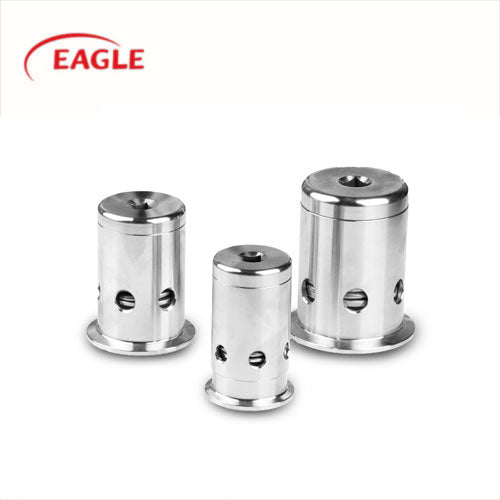
Automatically Open to Exhaust Air to Ensure Pressure
- Sanitary Pressure / Vacuum Relief Valve
- SUS304/316L
- Positive pressure 0.5 - 2bar, default 1 bar
- Negative pressure (vacuum): 0.3 - 0.9bar
- Temp. -10℃~135℃
- EPDM Sealing (Optional Silicone, FPM, NBR)
This sanitary pressure and vacuum relief valve is designed for use in order to maintain the pressure and vacuum levels within the operating limits for the 3-in-1 and 4-in-1 conical fermenters. The valve is preset to relieve pressure and break the vacuum.
Product Overview
The Eagle Sanitary Pressure and Vacuum Relief Valve is both a vacum and pressure safety valve that automatically keeps sealed sanitary tanks from getting over-pressure or vacuum. When internal pressure is higher than the generic pressure, the spring wafer opens to release excess air. When a vacuum takes place and needs to be relieved (for instance, after CIP cleaning), the valve opens letting air inside the tank in order to avoid the collapsing of the tank. The body is made of either 304 or 316L steel with EPDM seals which make this valve applicable to fermentation tanks, storage tanks, and any hygienic place where sealed devices need to breathe properly.
Technical Specifications
- Size Range: Φ34 (Tri-Clamp compatible), 1.0" to 3.5"
- Material: SUS304 or 316L Stainless Steel
- Positive Pressure Range: 0.5 – 2 bar (Default: 1 bar)
- Negative Pressure (Vacuum) Range: 0.3 – 0.9 bar
- Operating Temperature: -10℃ to 135℃
- Default Sealing: EPDM (Optional: Silicone, FPM/FKM, NBR)
- Connection Type: Sanitary Tri-Clamp (Bevel Seat)
Key Advantages of Our Sanitary Pressure/Vacuum Relief Valve
Dimensions

| Size | A (mm) | B (mm) | C (mm) | D (mm) |
|---|---|---|---|---|
| Φ34 | 25 | 34 | 49 | 30.5 |
| 1.0" | 25 | 50.5 | 49 | 30.5 |
| 1.5" | 35 | 50.5 | 72 | 42 |
| 2.0" | 47 | 64 | 85 | 51 |
| 2.5" | 59 | 78 | 90 | 64 |
| 3.5" | 83 | 105 | 135 | 88 |
Applications & Industries

Frequently Asked Questions
Why does a sealed sanitary tank need a vacuum relief function?
A vacuum condition is created inside a sealed tank under several circumstances, which include the cooling of a tank after undergoing a hot CIP cycle, when the product is discharged from the tank faster than the air can replenish, and when the caustic CIP solution absorbs CO2 from the head space. The failure of a properly functioning vacuum relief valve may cause the vacuum condition to occur, due to the atmospheric pressure acting outside the tank, being able to exceed the internal pressure and create conditions for the collapse of the structure.
What is the difference between a pressure relief valve and a pressure/vacuum relief valve?
A pressure relief valve operates when the internal pressure exceeds the pre-set level, guarding against high pressure. A pressure relief valve relieves the pressure and lets air in when the pressure decreases. Thus, in any container exposed to heat-cooling processes or pump-downs, such a dual-use valve is necessary to protect the container against both pressure boosts and vacuum conditions.
Can the factory set pressure and vacuum levels be adjusted?
Definitely. The set points for pressure and vacuum are determined by the specifications of the spring and the internal design of the valve. Eagle has the capability to set the valve at the factory according to your positive and negative pressure requirements, as per the ranges that are specified. Contact our engineering team with your design pressure and vacuum ratings, and we will make the necessary adjustments to the valve.
How do I select the correct seal material for my process?
EPDM This is the usual sealing material which is applicable to a number of food, dairy and brewing processes up to a temperature of 135 degrees Celsius. It can be replaced with FPM (Viton) for processes that involve higher temperature ranges or contain oil and aggressive solvents in the product or CIP chemicals. Silicone should be used for extremely high temperature SIP cycles. If the process involves animal or vegetable fats then NBR should be used as EPDM will deteriorate. It is necessary to specify the seal material at the order stage, as the valve calibration will be conducted referring to the already installed seal.
Why Choose Eagle Valves
Request Custom Quote
Contact our engineers for set point configuration, seal material selection, or application-specific recommendations
GET PERSONALIZED QUOTATIONResponse within 4 hours | Custom pressure and vacuum settings available | Competitive pricing with full documentation