

-
Free shipping
On all orders over $199
-
Special offers
Regular sales and discounts
-
Easy returns
Hassle free returns policy
-
Chat facility
Talk to a real person
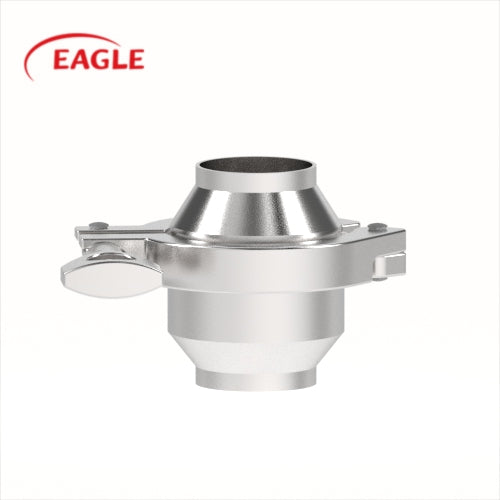
Sanitary Welded Check Valve
- Prevents process backflow
- 316L Stainless Steel Alloy
- 32Ra Finish (Roughness Average)
- Suitable for low and medium viscosity fluids
- Maximum operating temperature: 200°F
- Maximum operating pressure: 145 PSI
The Eagle Sanitary Welded Check Valve comes with 304 and 316L stainless steel alloy composition, and this makes it eligible for certification standards that govern the use of check valves in sanitary conditions. The welded valve body helps to eliminate threaded connections, and other hidden spaces in the working mechanism. The design of the valve allows for complete cleaning and draining. The sanitary check valve has a spring centrically placed in the check valve that closes the valve faster than the back-flow can occur.
Product Overview
Technical Specifications
- • Size Range: 1/2" to 4"
- • Body Material: 304 or 316L Stainless Steel
- • Surface Finish: 32Ra (Roughness Average)
- • Maximum Operating Temperature: 200°F
- • Maximum Operating Pressure: 145 PSI (10 Bar)
- • Certification: 3A Sanitary Standard
- • Connection Type: Butt Weld
- • Seat Material: EPDM (Standard); Viton (FKM) and PTFE available
Dimensions

| Size | A (Face‑to‑Face, mm) | B2 (Overall Height, mm) | D (Tube OD, mm) | Dn (Orifice ID, mm) |
|---|---|---|---|---|
| 1/2" | 70 | 76.5 | 12.7 | 9.4 |
| 3/4" | 70 | 76.5 | 19.05 | 15.8 |
| 1" | 70 | 76.5 | 25.4 | 22.1 |
| 1.5" | 70 | 87 | 38.1 | 34.8 |
| 2" | 80 | 100 | 50.8 | 47.5 |
| 2.5" | 90 | 115 | 63.5 | 60.2 |
| 3" | 100 | 128 | 76.2 | 72.9 |
| 4" | 100 | 164 | 101.6 | 97.4 |

Key Advantages of Our Sanitary Welded Check Valve
Applications & Industries
Frequently Asked Questions
What is a check valve in welding?
A welded check valve is a device used for backflow prevention that is permanently connected to the process piping using a butt welding process. Unlike a clamp valve that comes with gaskets and ferrules, a welded check valve has no removable parts because the valve body has been fused to the tubing through automatic orbital welding. The valve produces a smooth and uniform internal surface without any gaps or gaskets that may deteriorate and clamps that need to be re-tightened. In sanitary applications, welded connections have been used for permanent and safe applications since they do not create any possible contamination sites at the joint.
What are three types of check valves?
Sanitary check valve types can be classified into three distinct types. Let us look at these types in detail. These are spring-loaded ball check valves where a spring keeps the ball in place against a seat and the flow comes forward pushing the ball up to allow free passage. The second type is spring-loaded disc check valves where a spring holds the flat or profile disc in the right place against the seat. This is the type of configuration used in the valve seen in this page which is also the most commonly used type in hygienic processing. Thirdly, there are the swing check valves that open because of the action of the forward flow and close by gravity when the flow stops. It can be safely said that spring-loaded check types close faster than swing check types, and they can be installed in any orientation specifically while the swing check valves should be fixed in a proper position and are suitable for use in the large diameter pipes only.
Can you weld a valve?
A sanitary valve with butt-weld connections must be welded directly into the line of the particular process. The welding process must be carried out by an automatic welding machine operated by a qualified person and according to a certified welding technology. The weld must be penetrated totally, have a smooth and cremice-free, internal surface and be visually checked; in the case of the pharmaceutical application, it must also be boroscopically checked. The valve welded into a piping becomes an integral part of the system and cannot be removed without cutting the dear pipe. Therefore, welded valves are chosen for permanent installations, with no need for disassembly, and the absence of clamp loints allows one to reach the highest level of cleanliness and sterility.
What is the difference between welded and flanged valves?
A welded valve is a device that comes with butt-welding ends that allow for the immediate fusing of the valve and the adjacent pipe through orbital welding. A flanged valve, which is also referred to as a clamp valve, comes with Tri-Clamp ferrules that ensure the connection between the valve to the pipe via a clamp and gasket. The welded connection is permanent, creating a seamless joint that does not require the replacement of gaskets or retightening of clamps. The clamp connection, on the other hand, is renewable, therefore allowing for the removal of the valve for inspection, cleaning, and replacement. While welded valves are mostly preferred in sensitive settings where there is a need for cleanliness and sterility, the clamp styles are used in like juice and beer production processes where frequent disassembly is required. As a result, whether a welded connection or clamp connection will be used will depend on the needed level of sterilization, frequency of changing of lines, and the philosophy of maintainability and validation.
Why Choose Eagle Valves
Request Custom Quote
Contact our engineers for material selection, elastomer compatibility, and application‑specific recommendations
GET PERSONALIZED QUOTATIONResponse within 4 hours | Material and seat selection assistance | Competitive pricing with full documentation
