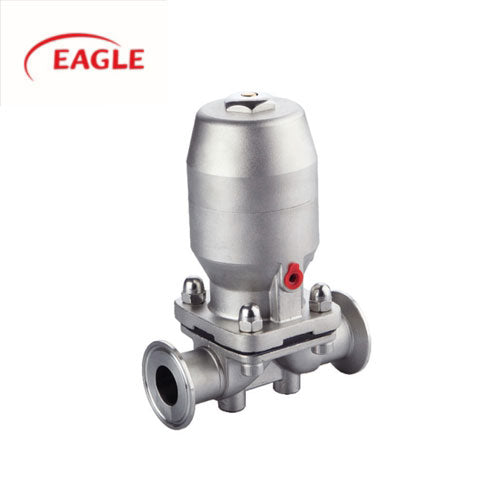
Sanitary Diaphragm Valves for high-purity process piping applications
- 3A Pneumatic Diaphragm Valves
- 316L for fluid contact
- Working Pressure 10 Bar
- EPDM Sealing: -20℃ ~ 135℃ ( 150℃ Max 20min )
- VMQ Sealing Optional
Combining world-class industry experience with engineering and manufacturing facilities located in both the USA and China. The valve body constructed from Stainless steel 316L with the manual or pneumatic operation, automated with a valve positioner. Connection End available in tri-clover/clamp, butt weld or thread. There is no path contact to the outer environment, specifically use for aseptic processes biopharmaceutical industries.
Product Overview: Pneumatic Diaphragm Valves
Eagle's 3A certified pneumatic diaphragm valves combine world-class industry experience with engineering and manufacturing facilities located in both the USA and China. Specifically designed for aseptic processes in biopharmaceutical industries, these valves ensure no path contact to the outer environment. The valve body is constructed from 316L stainless steel for fluid contact, with pneumatic operation available with optional valve positioner for automation.
Technical Specifications
-
• Valve Type: 3A Pneumatic Diaphragm Valve
-
• Size Range: 1/2", 3/4", 1", 1 1/2", 2"
-
• Price Range: $994 - $2,154
-
• Certification: 3A Sanitary Standard
-
• Body Material: 316L Stainless Steel
-
• Working Pressure: 10 Bar
-
• EPDM Sealing: -20℃ to 135℃ (150℃ Max 20min)
-
• VMQ Sealing: Optional
-
• Connections: Tri-Clover/Clamp, Butt Weld, Thread
-
• Operation: Pneumatic with optional valve positioner
Key Advantages of Our Pneumatic Diaphragm Valves
Complete Environmental Isolation No path contact to the outer environment, specifically designed for aseptic processes in biopharmaceutical industries
Dual-Country Manufacturing Combining world-class industry experience with engineering and manufacturing facilities in both USA and China
Flexible Sealing Options Standard EPDM sealing (-20℃ to 135℃) with optional VMQ sealing for varied process requirements
Multiple Connection Types Available in tri-clover/clamp, butt weld, or thread connections for seamless system integration
Applications for Aseptic Process Valves
Biopharmaceutical Processing: Specially designed for aseptic processes with no path to outer environment, ideal for sterile manufacturing, fermentation, and purification systems
Food & Beverage Production: Sanitary pneumatic valves for automated processing lines, ingredient handling, and clean-in-place systems requiring 3A certification
Cosmetics Manufacturing: Precision control for sensitive ingredient transfer and processing in GMP-compliant facilities
High-Purity Chemical Processing: 316L stainless steel construction for corrosive or ultra-pure chemical applications requiring automated valve control
Pricing & Configuration Options
| Valve Size |
Connection Type |
Standard Price |
Lead Time |
| 1/2" Pneumatic Diaphragm Valve |
Tri-Clamp/Clamp |
$994 |
2-5 business days |
| 3/4" Pneumatic Diaphragm Valve |
Butt Weld |
$1,083 |
2-5 business days |
| 1" Pneumatic Diaphragm Valve |
Thread |
$1,196 |
2-5 business days |
| 1 1/2" Pneumatic Diaphragm Valve |
Butt Weld |
$1,619 |
1-2 weeks |
| 2" Pneumatic Diaphragm Valve |
Tri-Clamp/Clamp |
$2,154 |
1-2 weeks |
Configuration Note: All prices include standard pneumatic actuation with EPDM seals. Optional VMQ seals, valve positioners for automated control, and different connection types (tri-clamp/clamp, butt weld, or thread) available upon request. Contact us for custom configurations.
Why Choose Eagle 3A Pneumatic Valves
✓
World-Class Manufacturing Engineering and manufacturing facilities in both USA and China ensure quality and supply reliability
✓
True Aseptic Design No path contact to outer environment, specifically designed for biopharmaceutical aseptic processes
✓
Flexible Automation Pneumatic operation with optional valve positioner for complete integration into automated process systems
FAQ
How does a pneumatic diaphragm valve work? A pneumatic diaphragm valve uses compressed air to actuate a flexible diaphragm that opens or closes the flow path. When air pressure is applied to the actuator, it moves the diaphragm against the weir, creating a tight seal. When air pressure is released, the diaphragm returns to its open position. This design completely isolates the process fluid from the actuator mechanism, making it ideal for sanitary and aseptic applications like those in biopharmaceutical industries.
What is the function of the diaphragm valve? The primary function of a sanitary diaphragm valve, particularly in pneumatic versions, is to provide reliable on/off or modulating control of process fluids while maintaining a sterile barrier between the fluid and external environment. In aseptic processes, this prevents contamination. The diaphragm itself acts as a seal and isolation barrier, ensuring no path contact to the outer environment, which is critical in biopharmaceutical applications.
What are the disadvantages of a diaphragm valve? While diaphragm valves offer excellent sanitary properties for aseptic processes, they have some limitations: 1) Pressure limitations (typically max 10 bar for sanitary designs), 2) Temperature constraints based on diaphragm material (EPDM: -20℃ to 135℃, with 150℃ maximum for 20 minutes), 3) Potential for diaphragm wear over time requiring periodic replacement, and 4) Higher initial cost compared to some valve types. However, for applications requiring no path to outer environment, these trade-offs are necessary.
What are the two types of diaphragm valves? The two primary types are: 1) Manual Diaphragm Valves - Operated by handwheel for applications where manual control is sufficient, and 2) Pneumatic (Air-Actuated) Diaphragm Valves - Automated valves using compressed air for remote operation, ideal for automated processes, frequent cycling, and integration with control systems. Both types maintain the sanitary diaphragm barrier principle but differ in actuation method, with pneumatic valves offering automation capabilities essential for modern bioprocessing facilities.
Request Engineering Support
Contact our engineers for 3A pneumatic diaphragm valve selection and application support
GET TECHNICAL SUPPORT
Response within 4 hours | Application engineering | Custom configuration support | Competitive pricing
Dimension
|
Size
|
L
|
L1
|
K
|
D
|
C
|
H
|
|
0.5"
|
108
|
125
|
62
|
12.7
|
50.5
|
135
|
|
0.75"
|
126
|
152
|
72
|
19.05
|
50.5
|
203
|
|
1"
|
126
|
154
|
72
|
25.4
|
50.5
|
207.5
|
|
1.5"
|
160
|
193
|
92
|
38.1
|
50.5
|
225
|
|
2"
|
193
|
225
|
114
|
50.8
|
64
|
240
|
| No. |
Description |
| 1 |
Cap |
| 2 |
Handwheel |
| 3 |
Screw |
| 4 |
Valve Rod |
| 5 |
Valve Cap |
| 6 |
Valve Core |
| 7 |
Diaphragm |
| 8 |
Valve Body |
| 9 |
Nut |
Installation